Datacenter Proxies Use Cases

Three jobs where a fast, unmetered server IP is the right tool

Datacenter proxies are servers hosted in commercial data centers rather than on home internet lines: a gigabit uplink at a low price per IP. Our pool holds 107 static IPv4 proxies in 107 networks across 33 countries, all paid for and absent from public free proxy lists; the 100-proxy plan gives you 100 of them, one from each subnet. Most buyers use them for one of these three jobs.

Web Scraping

Scrapers need throughput and IPs that survive. A gigabit data center uplink covers the first part, and unmetered bandwidth means a long crawl does not end in a per-GB bill. Because the 100 IPs sit in 100 different subnets, a block on one range takes out one proxy, not the whole job.

SEO & Ad Verification

Check rankings, SERPs and competitor ads from 33 countries without leaving your desk. The IPs are static, so a position that moves between checks moved because the site changed, not because your address did.

Automation & Account Management

Run price monitors, scheduled jobs and separate accounts on separate IPs, one per antidetect browser profile if that is your setup. Billing is per proxy rather than per gigabyte, so a task that runs all month does not quietly hit a traffic cap.

Want a new IP for every request? That is our rotating proxy service. If a strict site keeps blocking you, try residential proxies.

Datacenter Proxies vs Free Proxies

Free proxies are fine for a one-off check. They fall apart under anything scheduled.

Datacenter ProxiesFree Proxies
IP sourcePaid pool hosted in data centersPublic servers from open lists, origin unknown
IP reputationNever published on free listsOften already blacklisted
IP qualityEach IP is checked before it reaches your accountUnstable, and they die fast even when checked
Blocking riskLow on most sites, high on strict onesVery high
Speed & bandwidthGigabit uplinks, unlimited trafficSlow and unstable, connections drop
Uptime & support99% success rate, email supportNo SLA, nobody to ask
Pricing$0.48 per proxy per month, billed yearly$0.00
Best forScraping, rank tracking and automationA single lookup; try our free proxy list

A free list works for a quick check from your browser. It is a poor base for a scraper or a rank tracker: the proxies die, get rate-limited, or are already blocked before you start.

Datacenter Proxies in 100 Unique Subnets

Why one IP per subnet matters more than the IP count

When one IP draws too much abuse, sites rarely block that single address. The standard response is a range ban: the whole subnet goes, and every data center proxy in that range fails with it, even the ones that did nothing wrong.

100 subnets, not five

Budget packages often pull 100 proxies from five subnets or fewer, so one subnet-level rule takes the whole package offline. Ours sit one IP per subnet across 33 countries: a block costs you a single proxy, not the job.

Static IPs

The IPs are static: an address does not change between requests, which is what antidetect browsers are built for. Run one profile per proxy and each account keeps the same exit IP from one session to the next. You choose the countries, and you can refresh the mix every 10 days if a target starts pushing back.

Whitelist or username-password

Whitelist up to five addresses and skip credentials, or use a username and password where your tooling or team needs one. HTTP and SOCKS5 work from the same list, and every IP is tested before it reaches your account, so a protocol change is not a second purchase.

Try Datacenter Proxies Now
15-day money-back guarantee

How to Use Your Datacenter Proxies

Whitelist your IP or set a password, then load the list

Proxy List

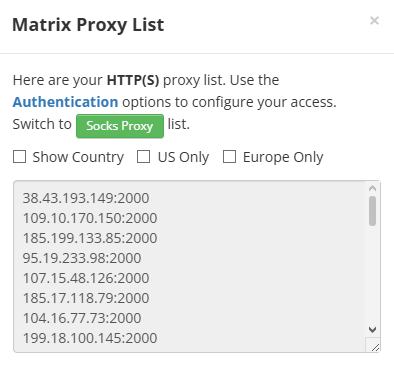
Copy the IP:port list into your scraper, browser or automation tool. The port is 2000 for HTTP and 3000 for SOCKS5, and the IP comes from your client area. Switch to the SOCKS5 list from the same page if you need it.

Proxy Authentication

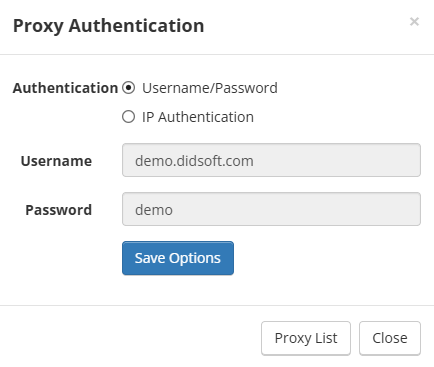
Use a username and password, or whitelist at most five IP addresses. To confirm it works, load http://ifconfig.co through one proxy: the page should show that proxy's IP, not yours.

Buy Datacenter Proxies
15-day money-back guarantee

Best Datacenter Proxy Providers

Starting prices, and the fine print behind them

ProviderStarting priceNotes
IPRoyal$1.80/IPSells from a single IP
Proxy-Seller$1.80/IPSells from a single IP
Bright Data$0.60/GB or $1.40/IPKYC verification required
Infatica$0.60/GB or $1.50/IPPay as you go
Decodo (Smartproxy)$0.60/GB or $1.85/IPPlans from $6/month
Oxylabs$0.60/GB or $1.00/IPPlans from $30/month
DataImpulse$0.50/GBPlans from $5/month
Free-Proxy-List.net$0.48~$1/IP100 IPs in 100 subnets, unlimited bandwidth, 5 whitelist IPs

Approximate starting prices as of October 2026, taken from vendor pricing pages. Per-GB and per-IP plans are not directly comparable, and several vendors have a monthly minimum.

Datacenter Proxy Pricing

15-day money-back guarantee. Cancel at any time.

Monthly Yearly Save 20%

Matrix 100
$59.9847.98
/ month
($0.600.48 / proxy)
100 Datacenter Proxies
100 Unique Subnets
Unlimited Bandwidth
HTTP(S) & SOCKS5
5 Whitelist IPs
Matrix 50 Most Popular
$39.9831.98
/ month
($0.800.64 / proxy)
50 Datacenter Proxies
50 Unique Subnets
Unlimited Bandwidth
HTTP(S) & SOCKS5
2 Whitelist IPs
Matrix 10
$9.987.98
/ month
($1.000.80 / proxy)
10 Datacenter Proxies
10 Unique Subnets
Unlimited Bandwidth
HTTP(S) & SOCKS5
1 Whitelist IP

* Not enough IPs? Try our Rotating Proxy service. It has 12134 IPs.

We accept PayPal, credit cards, Alipay, Bitcoin, and many other payment methods. All plans include a 15-day money-back guarantee.

payment methods

Datacenter Proxies FAQ

Frequently asked questions about datacenter proxies

Datacenter proxies are proxy servers hosted in commercial data centers rather than on residential internet lines. They are fast, stable and cheap per IP, and strict websites can spot them more easily. Ours come from a pool of 107 proxies in 33 countries with a 99% success rate. The 100-proxy plan is shared: you get 100 IPs from 100 different subnets, not exclusive use of each address.

Some people spell it data centre proxies. It is the same product.

Cheap datacenter proxies from us start at $0.48 per proxy per month on yearly billing, or $0.60 on monthly billing. You pay per IP, never per gigabyte, so traffic does not change the bill.

The three plans are 10 proxies for $9.98/month, 50 for $39.98 and 100 for $59.98.

These are static. An IP does not change between requests, which is what you want for logins, rank checks and any job where the session needs to stay put. You can request a fresh list every 10 days; if you never refresh, the addresses stay fixed.

For automatic rotation, use our rotating proxy service instead.

They are shared. More than one customer can use the same IP, which is why the price is $0.48 instead of the $5 to $10 that dedicated datacenter proxies usually cost. We do not sell dedicated IPs on this product.

Private here means the pool is paid and stays off public lists. Shared only means another customer may use the same address at the same time.

Sometimes. Social networks, ticketing sites and some e-commerce checkouts treat data center ranges as bot traffic and answer with a block or a CAPTCHA. That comes with the IP type, and no datacenter proxy avoids it completely.

If a target is strict, residential proxies carry a much lower blocking risk.

Web scraping, rank tracking, ad verification, price monitoring, and running several accounts or scheduled jobs. Sneaker and ticket drops use them too, although the stricter the site, the more blocks you should expect.

The use cases section above covers the three most common jobs.

Yes. Load the IP list into AdsPower, Multilogin, GoLogin, Dolphin Anty or any other antidetect browser, and give each profile one proxy from it. Both protocols work: HTTP on port 2000, SOCKS5 on port 3000.

Authenticate with a username and password or a whitelist of up to five addresses. Because the IPs are static, a profile keeps the same exit IP between sessions.

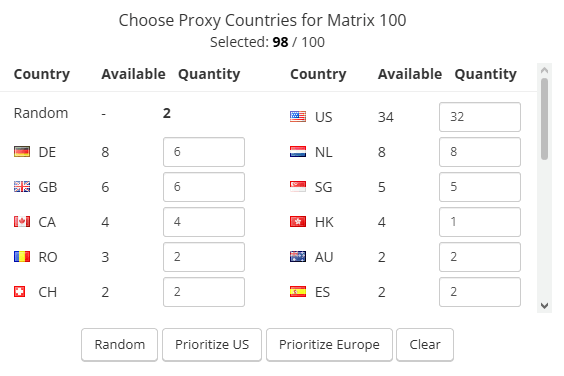
Choose your countries at checkout from what is available. The pool covers 33 countries right now, including the US, UK, Germany, France, Canada, the Netherlands and Singapore. Availability per country moves as IPs come and go.

You can change the mix every 10 days. Authentication is either a username and password or IP whitelisting, up to five addresses on the 100-proxy plan.

Two authentication methods, and you pick one.

  • Username and password: use this when your own IP changes from time to time.
  • Whitelist IP: use this when your program cannot send credentials. The 100-proxy plan allows 5 addresses.

You can switch between them in the client area at any time.

A subnet is a group of IP addresses that share the same network block, usually written as a range such as 192.0.2.0/24. Sites and firewalls often block a whole subnet at once, so IPs spread over many subnets are harder to knock out together.

Because a subnet block is the usual way a site stops proxy traffic. If your 100 proxies come from five subnets, one rule kills all of them. With one IP per subnet, a block costs you one proxy and the rest of the job keeps running.

It is the main structural difference between this plan and sub-$1 per-IP packages elsewhere.

Yes. There is no traffic cap and no per-GB charge. You pay per proxy per month, and the bytes you push do not appear on the invoice. We ask that you stay within normal use and do not resell the proxies.

Both. Every proxy in the list works as an HTTP proxy and as a SOCKS5 proxy on the same host, so you can switch per client or per request without buying a second product.

SOCKS5 is the better fit for non-HTTP traffic and for tools that keep one connection per host.

Yes, all 100 are IPv4. There is no IPv6 in the list. If your stack is IPv6-only, this product will not fit.

Datacenter IPs are faster and much cheaper per IP, and easier to detect. Residential IPs look like ordinary home visitors, cost more and are usually billed per gigabyte.

Use datacenter for volume on sites that tolerate it, and residential for strict targets. We sell residential proxies too, and the proxy services comparison puts them side by side.

Free proxies are free because nobody maintains them. They are slow, they disappear without warning, and most are already on blocklists. A paid pool is maintained and unmetered, which is the part that matters when a job runs on a schedule.

If you only need one manual check, our free proxy list is fine.

Look at four things before the headline price: where the IPs come from, whether bandwidth is metered, how many distinct subnets you actually get, and the real minimum spend. A $0.50/GB headline often hides a monthly plan minimum.

The provider comparison above lists starting prices and those caveats.

Pick a plan, choose your countries, and pay with PayPal, a credit card or one of the other methods we accept. The proxy list and authentication details appear in your account right after payment.

Billing is per proxy. A second license draws from the same pool and does not add addresses, so choose a larger plan if you need more IPs.

No. We block SMTP ports 25, 587 and 465, so these proxies cannot send email. We are not aware of any proxy vendor that sells mailing proxies.

No. Two licenses draw from the same pool, so the pool does not grow. For more addresses, take a larger package or add rotating proxies.

We do not offer a free trial. Our $3.98 three-day trial includes 50 datacenter proxies from the same pool as our monthly plans, so you can test your target site and tooling before signing up for a monthly subscription.

Every paid plan also includes our 15-day money-back guarantee.

Click a question to expand or collapse it.

Datacenter Proxy Network Status

107 datacenter proxies in 107 subnets across 33 countries

Total 107 IPs in 107 Subnets in 33 Countries
Total107Subnet 107Google107Europe49Asia18LatAm3
US
36
NL
8
DE
7
GB
6
HK
5
SG
5
CA
4
RO
3
JP
3
AU
2
PL
2
SE
2
CH
2
IN
2
ES
2
BR
1
NZ
1
FI
1
MD
1
EE
1
IL
1
TR
1
CL
1
IE
1
HU
1
LV
1
BG
1
FR
1
BE
1Others4

Try 50 datacenter proxies for 3 days – $3.98

Start 3-day trial – $3.98